
What is a testimonial ad?
A testimonial ad is an ad where a real customer, not the brand, makes the promise. It shows their words, face or result: a quote on an image, a screenshot of a review, a video of the client talking, or a before-and-after story. The reader trusts someone like them more than a seller, so the claim lands with less resistance.
Two close cousins get mixed up with it:
- Endorsement: a person with authority vouches for you (an expert, a media outlet, a well-known peer). It borrows credibility. A testimonial borrows similarity.
- Celebrity testimonial: a famous face says they use the product. The Institute for Propaganda Analysis listed it among its seven propaganda devices in 1937, next to bandwagon and plain folks. For a coach or a consultant it rarely applies: your best witness is a client your reader recognises as themselves.
This article looks at testimonial ads from one angle the usual lists skip: which ones advertisers keep paying for. We pulled the long-running ads of course creators, educators and service businesses from Pantheon's library and checked how many use testimonials, in what format, and what they pair them with.
Do testimonial ads work? What months-long ads tell us
Yes, when they are specific, and less often than you might think. Among 1,079 ads from educators and service businesses running for 90+ days, 3.4% used a customer testimonial. Most of those told a client story: where the client started, how long it took and what changed. Bare reviews were rare.
Why duration? Nobody can see another advertiser's results, but anyone can see how long an ad has been running. An ad that stays live for 90 days or more has been paid for, and looked at, ninety times.
We took the 1,079 public ads from course creators, educators and service businesses running for more than 90 days in Pantheon's library. Each had its persuasion mechanisms classified (extraction of 27 October 2026). Here is how often social proof shows up:
| Type of social proof | Share of the 1,079 ads | What it looks like |
|---|---|---|
| Customer testimonial | 3.4% | A named client tells their story or a review is quoted |
| Numbers of customers or results | 8.6% | "10,000 parents", "4.9 stars", "92% of users" |
| Before / after | 8.1% | Where the client started, where they ended, and how long it took |
| At least one of the three | 18.0% |
Two things stand out.
- Pure testimonials are rare among long-running ads: about 1 in 30. In our earlier extraction for the Meta Ads Library guide, identity, free value and problem agitation each appeared in roughly a third of the long-running ads. A testimonial is one tool among them.
- When a testimonial does survive, it is almost never a bare review. Of the 37 ads with a customer testimonial, 37.8% also tell a before-and-after story, 24.3% speak to the reader's identity and 16.2% are built as an emotional story. The testimonial that lasts is a client story with a starting point, a timeframe and a result.
Do testimonial ads run longer than others? Our sample cannot say. Among educators, the median testimonial ad had run for 219 days against 186 for the rest; among service businesses it was 157 against 186. With 16 and 21 ads in each group, that is noise, not a finding.
How to read these numbers: ads enter Pantheon's library through keyword searches with a minimum-duration filter and through a curated selection, so they describe what a surviving ad looks like, not how many ads survive. Duration is measured up to the last check, so for ads still running it is a lower bound. Mechanisms are classified by Pantheon's AI on a closed list of 22; an ad can have several. Full method on our methodology page.
6 testimonial ad formats, and when to use each
Among the long-running testimonial ads, video dominates: 73% of them, against 16.2% carousels and 10.8% single images. That tracks with the "story" pattern above: a story needs time, and video gives it. The six formats you will meet most:
| Format | Best for | Watch out for |
|---|---|---|
| Client story video | High-ticket programs, coaching, courses: the reader needs to see a person like them change | A long intro before the result. Put the outcome in the first 3 seconds and the story after |
| Quote card (image) | A short, specific line with a number or a timeframe | Vague praise ("Amazing coach!") reads as fake |
| Review screenshot | Low-cost offers, apps, books: the stars and the platform logo do the work | Use real reviews, with permission, and do not edit the wording |
| Before / after carousel | Visible change: fitness, skin, design, language level, revenue | Meta restricts before/after images in some categories, such as weight loss and cosmetic procedures. Check the Advertising Standards for yours |
| Case study with numbers | B2B services and consultants: revenue, hours saved, clients signed | Say whether the result is typical. US rules require it |
| Testimonial series | Several clients, one ad each, same structure | Keep each story distinct: different starting point, objection and result |
Real testimonial ad examples from long-running ads
These ads come from Pantheon's public library. We checked each one in the Meta Ad Library on 27 October 2026: four were still running, two had been switched off after more than two years. We quote a few words and describe the rest; open the live ones to see them in full.
1. The client protocol story (909 days, then switched off)
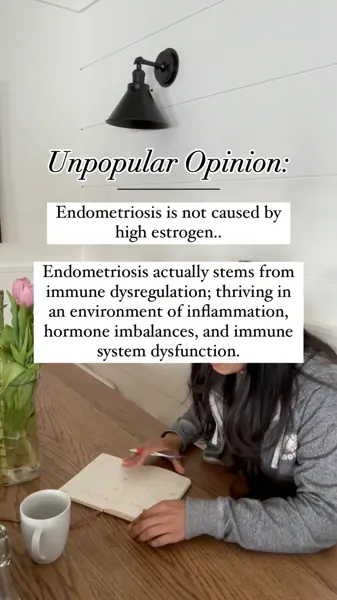
Endo Nutrition, a nutrition practice for women with endometriosis, had kept this video running for 909 days. It opens with a call to comment for details, then tells one client's three-month path: less pain, more energy, without the options the reader already fears (restrictive diets, painkillers, repeat surgery). Mechanisms: testimonial, before/after, free value. The testimonial is the proof; the free value ("comment DETAILS") is the low-effort next step. The video opens on an "unpopular opinion" card that busts a myth about the condition, then hands over to the client's story. The advertiser has since switched this ad off, so it is no longer in the library.
2. The testimonial that busts a myth (760 days, then switched off)
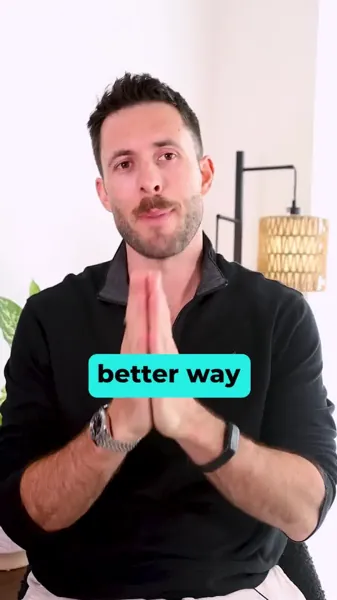
Prevent Divorce with Josh Hudson runs a video that opens with a client's quote attacking marriage counselling. The client says what the coach could not say as bluntly himself. Mechanisms: common enemy, myth busting, testimonial, running for 760 days. Use it when your offer goes against the accepted solution in your market: let a client name the problem with that solution. This ad has since been switched off.
3. The testimonial series (5 ads, the oldest live for 762 days)
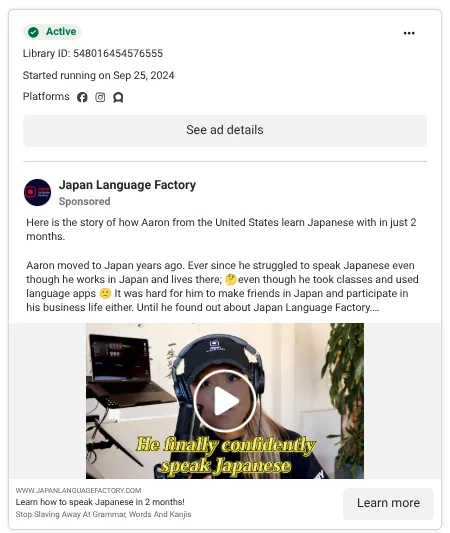
Japan Language Factory, an online Japanese school, runs one video per student with the same skeleton: name, where they live, why they struggled (apps, textbooks), how long it took, what they can do now. Five of them were among the longest-running testimonial ads in our sample. The oldest has been running since 25 September 2024: 762 days on 27 October 2026. Mechanisms: testimonial, before/after, sometimes problem agitation. A series lets each reader find the student closest to them: the busy professional, the parent, the anime fan. See the ad.
4. The B2B case study with numbers (188 days)
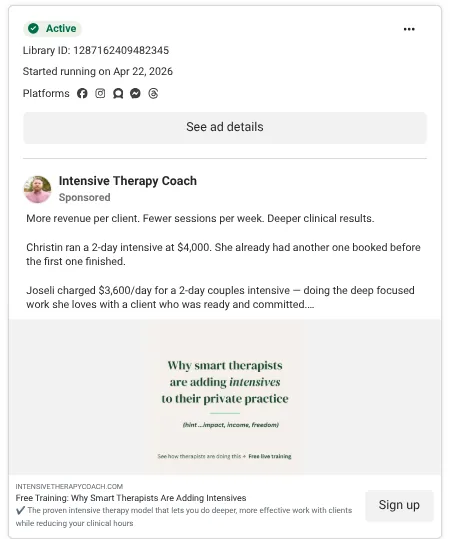
Intensive Therapy Coach sells a method to therapists for running multi-day intensives. This single image lists clients with their price and outcome: one ran a 2-day intensive at $4,000 and had the next one booked before the first ended. Mechanisms: free value, testimonial, numbers. For a B2B reader, a figure from a peer beats any adjective. Running since 22 April 2026: 188 days. See the ad.
5. The star-rating quote (167 days)
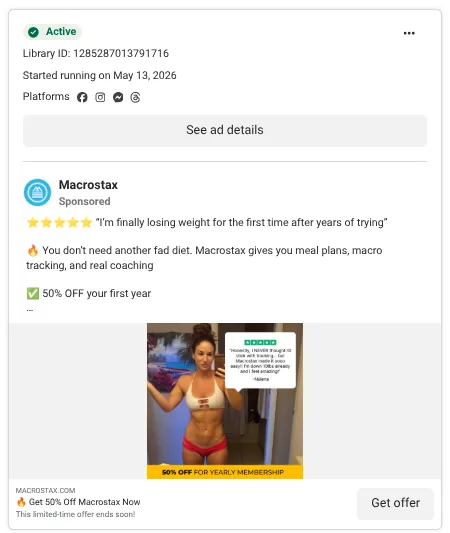
Macrostax, a nutrition coaching app, puts five stars and one short sentence from a customer at the top of a static image, then a discount with a deadline. Mechanisms: testimonial, price anchoring, urgency, running since 13 May 2026: 167 days. It is the review-screenshot pattern done in a single line: short, specific, believable. Note the second testimonial inside the image itself. See the ad.
6. Statistic plus first person (148 days)
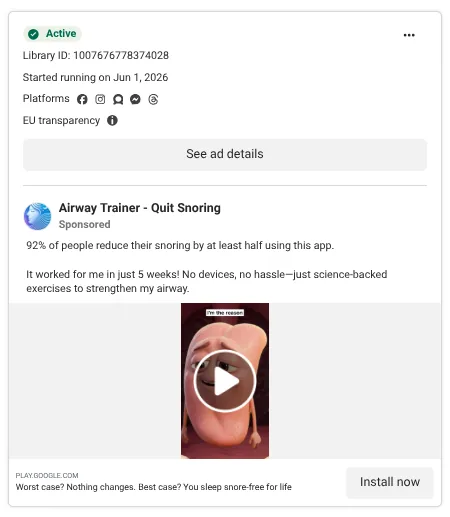
Airway Trainer, an anti-snoring app, opens with a percentage of users who improved, then switches to a first-person line ("It worked for me in just 5 weeks"). Mechanisms: numbers, risk reversal, testimonial, running since 1 June 2026: 148 days. The number gives scale; the first person gives a face to it. The library shows 7 ads using this creative and text: the advertiser is scaling it. See the ad.
What the six have in common: a specific person, a specific starting point, a timeframe and a result. None of them relies on "Great service, highly recommend".
What makes a testimonial believable
Readers have seen too many fake reviews to trust praise. What they trust is detail they could check. Run your testimonial through these five tests:
- Specific result. "Booked 3 new clients in 2 weeks" beats "Changed my business".
- Starting point. Say where the client was before. Without the "before", the "after" means nothing. That is why before/after is the mechanism most often paired with testimonials in our sample.
- Timeframe. "In 3 months", "after 6 weeks". It makes the result feel reachable and sets expectations.
- Someone like the reader. Same job, same doubt, same situation. This is the identity mechanism, present in a quarter of the long-running testimonial ads. It is one of the 22 persuasion mechanisms Pantheon reads in every ad.
- The objection, answered. The best testimonials start with the doubt: "I had tried apps and textbooks for years…". The reader hears their own objection fall.
How to write a testimonial ad, step by step
- Collect stories, not compliments. After a result, ask three questions: where were you before, what did you try that did not work, what changed and how fast? Record the call if you can: the client's own words are your copy.
- Get written permission. Ask for consent to use their name, photo, words and result in ads. Keep it on file.
- Pick one line for the hook. The most specific sentence goes first: the result with its timeframe, or the objection in the client's words.
- Build the body as before → turning point → after. Keep it in the client's voice. Add your offer only at the end.
- Add one low-effort next step. A free guide, a short call, a "comment DETAILS". About 1 in 9 long-running testimonial ads in our sample pairs the story with free value.
- Make one ad per client and test several. A series reaches different readers; the market tells you which story to scale.
Testimonial ad checklist: specific result · starting point · timeframe · a reader can see themselves · objection answered · written permission · typical results stated · one clear next step.
Rules: fake reviews, typical results and Meta policies
Testimonials are the part of advertising most exposed to regulation. The main rules in the United States, which many other markets echo:
- No fake or paid-for testimonials. The FTC rule on consumer reviews and testimonials has been in force since 21 October 2024. It bans fake reviews and testimonials, including AI-generated ones attributed to people who never used the product. It also bans buying reviews and undisclosed reviews from employees or insiders. Federal Register, 22 August 2024.
- Say when a result is not typical. The FTC Endorsement Guides were updated in June 2023. When a testimonial shows an exceptional result, you must say what customers can generally expect. The disclosure must be hard to miss, not buried at the end of a caption. 16 CFR Part 255.
- Disclose connections. If the person in the ad is paid, gets a discount or is a friend, say so.
- Meta's own standards. Meta limits before/after images and claims about personal attributes in health, weight loss and some other categories, and reviews ads against its Advertising Standards. Meta also lets brands add testimonials from partners in partnership ads.
This is a summary for marketers, not legal advice. Rules differ by country and by category; check them for your market before launching.
How to find testimonial ads in your market
The fastest source is the Meta Ad Library: it is free, public and shows when each ad started running.
- Search keywords clients use in testimonials, with your niche: "my client", "in just", "results", "before", "review".
- Keep only active ads and add an Impressions by date filter that ends 30 to 90 days ago. What remains are ads still running that were already running back then: the survivors.
- Open the ones with several versions. An advertiser who duplicates an ad is usually scaling it.
Our free Meta Ad Library search builder sets those filters for you. Want this done around your offer? Pantheon's radar finds the ads that have run for months in your market and tags the persuasion mechanisms in each one, testimonials included. The radar is part of the Pro plan (see plans).
Find the testimonial ads that last in your market
Pantheon finds the ads that have been running for months for offers like yours and tags their persuasion mechanisms, testimonials included. The radar and the analysis are in the Pro plan; you can try Pantheon free for 5 days, no card.
Start my 5-day free trialNo credit card required
Testimonial ads: frequently asked questions
What is the difference between a testimonial and an endorsement?
A testimonial comes from a customer who used the product and reports their experience. An endorsement comes from someone with authority or fame who vouches for it. Testimonials build trust through similarity; endorsements through credibility.
Are testimonial ads effective?
They can be, if they are specific. In our sample of 1,079 long-running ads from educators and service businesses, 3.4% used a customer testimonial, and most of those told a client story with a before, a timeframe and an after, not a bare review.
Can I use Google or Facebook reviews in my ads?
Yes, if they are genuine and you have permission to use the reviewer's name and words. Do not edit the meaning, and do not use reviews you paid for or that come from staff without disclosing it.
How long should a testimonial video ad be?
Long enough for the story, short enough to hold attention. Put the result in the first three seconds, then the before and the turning point. The long-running client story videos in our sample usually told one person's path, not a montage.
What is testimonial propaganda?
In media studies, "testimonial" is one of the classic propaganda techniques: a respected or famous person endorses an idea or a product so that the audience transfers their trust. In marketing, the term usually means a customer testimonial.

Written by
Henok Ey. Anani
Founder of Pantheon
Henok builds Pantheon and studies the Meta ads that keep running for months, with Pantheon's 22 persuasion mechanisms and Meta's EU transparency data. Every number on this page has a source or comes from Pantheon's data, with the method stated.