
What is competitor ad analysis?
Competitor ad analysis means reading a rival's ads to find out who they target, what they promise and why the ad persuades, so you can write your own. Finding the ads takes minutes in the free Meta Ad Library. The useful part comes after: naming the mechanism that makes an ad work and moving it into your offer without copying a word.
Most guides stop at "here is how to see your competitors' ads". This one starts there and walks through a real analysis of a coaching ad that has been running since January 2023.
Where do you find your competitors' ads?
On Facebook and Instagram, every active ad is public in the Meta Ad Library, free and without an account. Search the advertiser's name or a phrase from their offer, pick your country and keep Active ads. Our Meta Ads Library guide explains every filter, and the free search builder writes the search for you.
Google, TikTok and LinkedIn have their own public libraries. If you sell coaching, consulting or a course, start with Meta: that is where most of your competitors' paid ads run.
Which competitor ads are worth analysing?
Analyse the ads that have been running for 30 days or more. Nobody pays for months for an ad that loses money, so the start date on each ad card is the strongest public signal of what sells. An ad launched last week is still a test.
- Under 30 days: still being tested. Note it and come back later.
- 30 to 90 days: it survived the first tests. Worth a closer look.
- Over 90 days: the market has paid for it. Analyse it in full.
Duration can mislead on its own: brand budgets and retargeting keep some ads alive. Check the secondary signals too, such as several versions of the same ad and, in the EU, a large reach.
How to analyse a competitor ad in 4 steps
Take one surviving ad and answer four questions in order. Write one line per answer; a full page means you are describing the ad instead of reading it.
- Who is it for, and how aware are they? Read the first line. Does it name a problem the reader already feels, a solution they already compare, or a brand they already know? That tells you the awareness level.
- What is the promise? One sentence: the result the reader gets, and what they avoid on the way.
- Which mechanism carries it? Name the persuasion lever under the copy: identity, free value, problem and agitation, authority, curiosity, social proof. Most surviving ads combine two or three.
- Does the landing page keep the promise? Click through. If the headline and the offer match the ad, the whole path has probably passed the same test.
A real example: a weight coach ad running since 2023
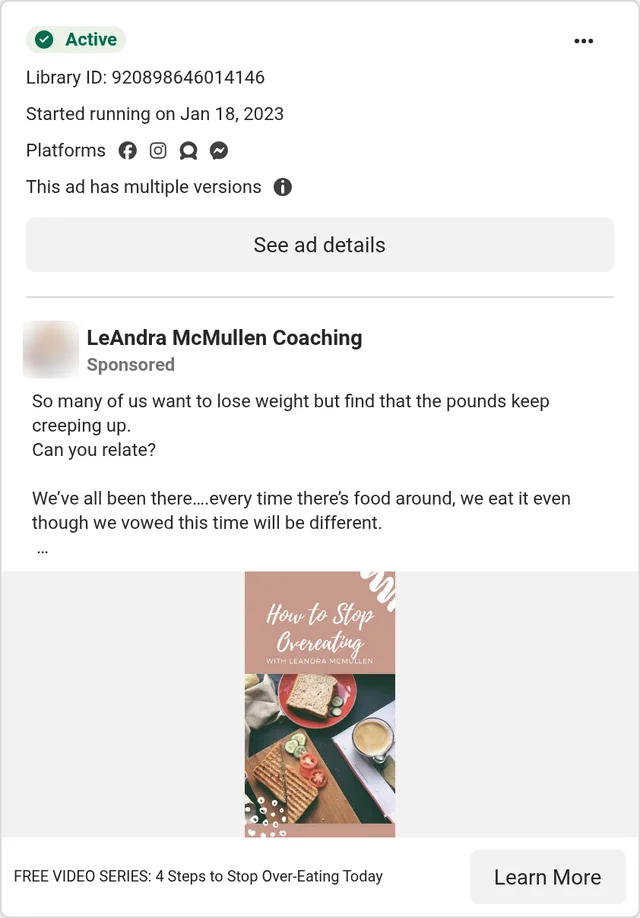
LeAndra McMullen presents herself as a certified life and weight coach for Christian women. Her ad for a free video series, "4 Steps to Stop Over-Eating Today", started running on 18 January 2023 and was still active in the Meta Ad Library on 16 November 2026: 1,398 days. In May and July 2026 she launched new ads with the same text and different visuals, a sign that she is scaling a message that works.
| Step | What the ad does | What it tells you |
|---|---|---|
| Who and how aware | Opens on a feeling the reader already has: the pounds keep creeping up. Pantheon rates the audience Problem Aware | She speaks to people who know the problem but not her or her method |
| Promise | Stop over-eating without being hungry all the time | The promise removes the cost the reader fears most, hunger |
| Mechanisms | Guilt removed ("nothing has gone wrong"), a named in-group (Christian women), curiosity (the "4 simple steps"), free value | Identity and free value are also the two most common levers in long-running ads (table below) |
| Landing page | Same audience, same 4 steps, same pain points. Pantheon scores ad-to-page coherence at 95 out of 100 | The click lands exactly where the ad promised |
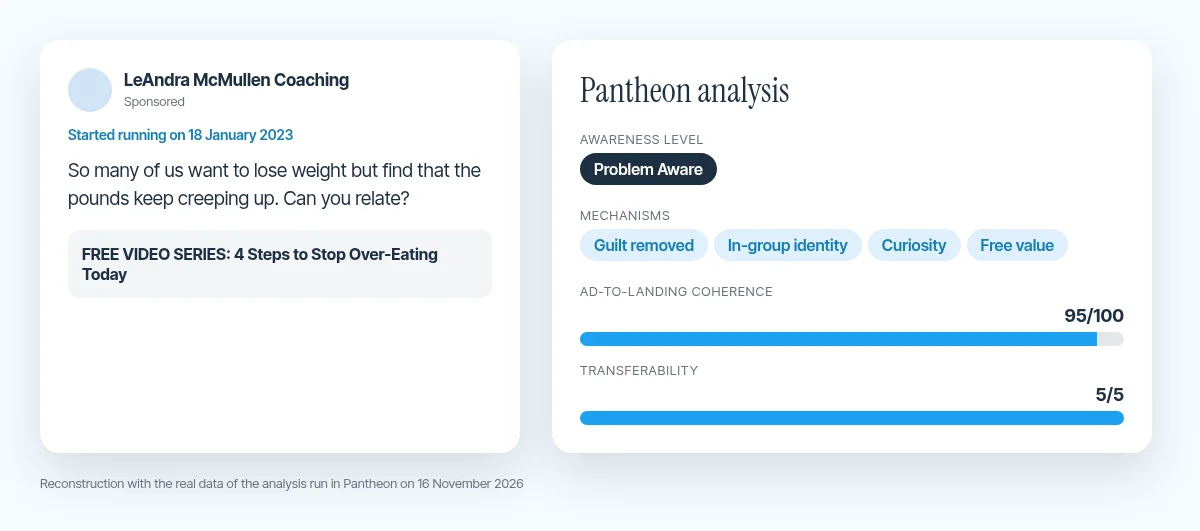
The order of the copy matters as much as the levers: shared frustration, then absolution, then her authority as a certified coach, then a simpler way, then the free offer. Pantheon gave this structure a transferability score of 5 out of 5: it works for a business coach or a consultant with the same sequence and different words.
Sources: the ad in the Meta Ad Library (Library ID 920898646014146), checked on 16 November 2026; analysis run in Pantheon the same day. We quote short passages for commentary only.
What do competitor ads that last have in common?
We classified 769 ads from course creators, educators and service businesses that had been running for more than 90 days in Pantheon's library (extraction of 23 October 2026). The levers that show up most:
| Persuasion mechanism | Share of long-running ads |
|---|---|
| Identity | 37.6% |
| Free value | 32.9% |
| Problem-agitation | 30.6% |
| Authority | 22.8% |
| Curiosity | 18.6% |
| Social proof in numbers | 8.5% |
| Scarcity | 5.7% |
| Urgency | 5.6% |
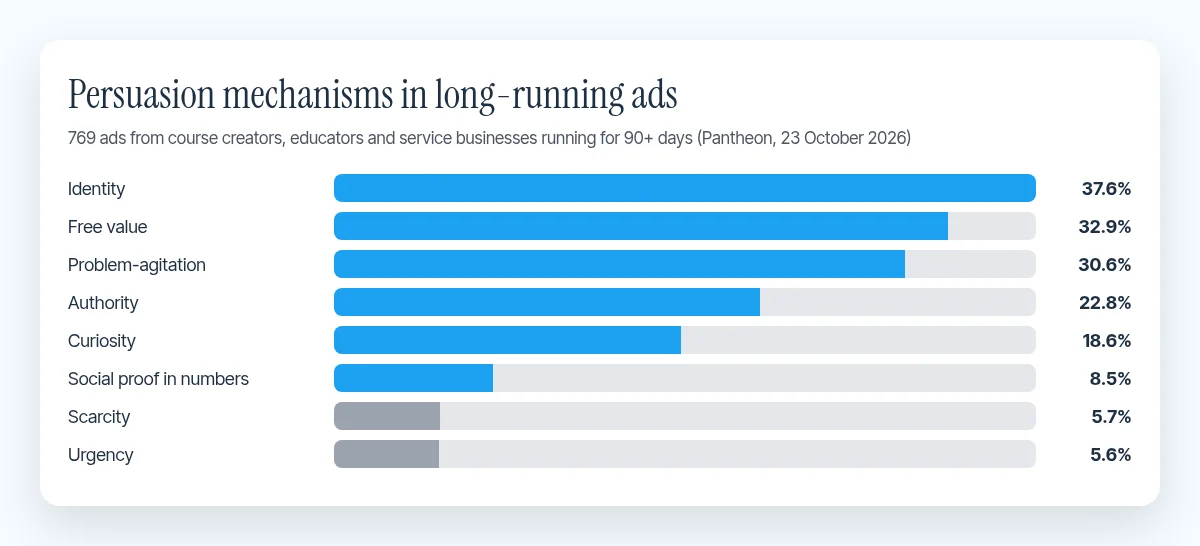
Scarcity and urgency appear in fewer than 1 long-running ad in 17. When you analyse a competitor, look first for identity, free value and a precisely named problem: those are what keep ads alive in this market. An ad can use several mechanisms, so the shares don't add up to 100%. The full list of 22 is on our persuasion mechanisms page.
How to turn the analysis into your own ad without copying
Copying a competitor's ad makes you sound like them, and their words, images and testimonials are protected. Move the mechanism instead:
- Write the mechanism in one line, for example: remove the guilt, name the group, offer a simple free first step.
- Find the same moment in your client's life. A business coach's client has their own version of "the pounds keep creeping up": the calendar is full and revenue hasn't moved.
- Write three hooks with that mechanism and your own words, then test them against your current ad with the same budget.
An AI ad copy generator writes from a blank prompt, so it guesses what your market wants. Pantheon starts from an ad your market has already paid for. Its Adapter, on the Pro plan, takes the competitor ad you pick and writes 3 variants for your offer with your Avatar and your Brand Voice. It is instructed to transfer the mechanism and never the wording.
Start from an ad your market already pays for
Paste your website link and Pantheon prepares your Avatar, Brand Voice and Offer Brief. Then pick a competitor ad that has been running for months and get 3 variants written for your offer.
Start my 5-day free trialNo credit card required
How often should you analyse competitor ads?
Once a week is enough for most coaches and consultants: 20 minutes to note new ads, ads that disappeared and one mechanism to test. The routine is in our Meta Ads Library guide. Comparing tools for it? See our ad spy tools comparison.
Competitor ad analysis: frequently asked questions
Is it legal to analyse competitor ads?
Yes. Meta publishes active ads in its Ad Library on purpose. Studying them is legal; reusing someone else's copy, images or videos as they are is not, because they are protected by copyright.
How many competitor ads should I analyse?
Start with 5 to 10 ads that have been running for 30 days or more, from 3 competitors who sell to the same client as you. Patterns show up quickly; a hundred ads add little.
Can I see how much a competitor spends on Meta ads?
Not for commercial ads: the Meta Ad Library shows spend only for social issue, electoral and political ads. Use indirect signals instead: how long an ad has run, how many versions it has and, in the EU, its reach.
Is an AI ad copy generator enough?
It writes quickly, but from a prompt, so it doesn't know what sells in your market. Start from an ad that has been running for months, name why it works, then use AI to write your version of that mechanism.
What is the difference between competitor ad analysis and an ad spy tool?
An ad spy tool finds and stores ads. Analysis is the step after: deciding why one ad works and what to take from it. Some tools do both; most only do the first.

Written by
Henok Ey. Anani
Founder of Pantheon
Henok builds Pantheon and studies the Meta ads that keep running for months, with Pantheon's 22 persuasion mechanisms and Meta's EU transparency data. Every number on this page has a source or comes from Pantheon's data, with the method stated.