
What is competitor ad tracking?
Competitor ad tracking means checking your competitors' ads on a schedule and getting told when they launch new ones, so you see a new offer or angle while it is still running. On Meta you can do it by hand in the free Ad Library. A tracking tool does the checking for you and keeps the ads that later disappear.
This page explains how Pantheon's Competitor Spy tracks Facebook and Instagram advertisers, how often it checks, what each alert contains and what it doesn't do.
How does competitor ad tracking work in Pantheon?
- Spy a page once. Competitor Spy pulls all the active ads of a Facebook page: formats, calls to action, landing pages, its top 10 ads with their media and, for ads shown in the EU, their reach and audience.
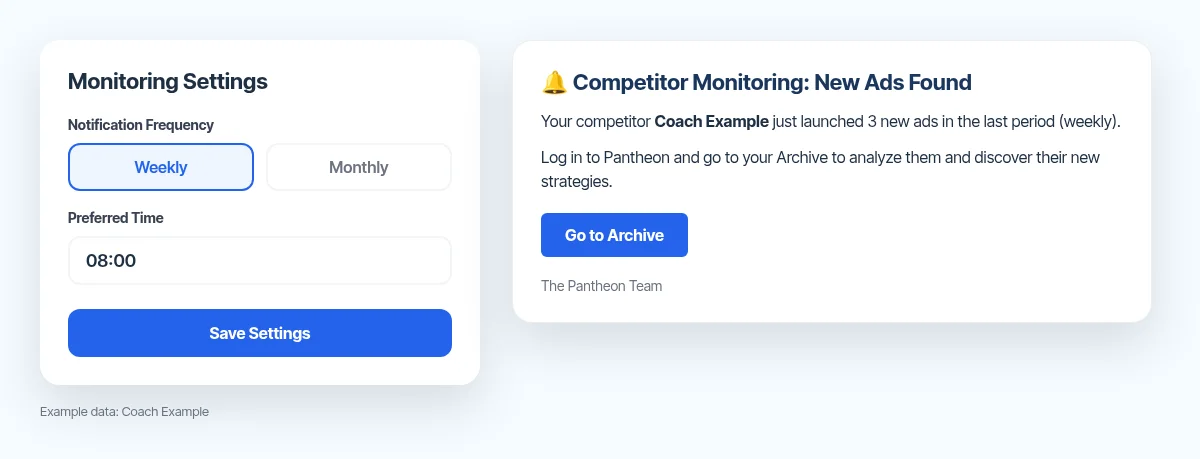
- Turn on monitoring. From the page folder you pick weekly or monthly checks, the time of day and the language of the emails.
- Pantheon rechecks the page on schedule. Each check runs the same analysis again, adds the new ads to the folder and marks the ones that are no longer running.
- You get an email only when there is something new. It says how many new ads the page launched and links to the folder.
How often do you get competitor ad alerts?
Pantheon checks each page you follow once a week, or once a month if you prefer, at the time you choose. Some alert tools check daily or every few hours. A weekly check fits how coaches and consultants work: an ad needs 30 days or more to prove it sells, so a few days' delay costs you nothing when you are looking for ads worth studying.
You can change the frequency or the time, or turn monitoring off, at any moment from the page folder.
What do you see when a competitor launches new ads?
| Meta Ad Library by hand | Pantheon Competitor Spy | |
|---|---|---|
| Who checks | You, page by page | Pantheon, on your schedule |
| When you hear about new ads | When you remember to look | By email, only when there are new ones |
| Ads that stop running | Disappear outside the EU | Stay in your folder, marked as inactive |
| EU reach and audience | Open each ad's details | Collected for every active ad |
| Why an ad works | Not shown | Awareness level and persuasion mechanisms, on the Pro plan |
From the folder you can open any new ad in the analysis, or send it to the Adapter to write 3 variants for your offer. Our competitor ad analysis guide shows the method on a real coaching ad.
Which platforms does it track?
Meta only: the Facebook and Instagram ads published in the Meta Ad Library. Pantheon doesn't track Google, TikTok or LinkedIn ads, nor competitors' funnels or organic posts. If you need those, tools like Whoscale or Panoramata cover more channels; our ad spy tools comparison lists what each one does.
Can you track competitors you don't know yet?
Competitor Spy follows the pages you name. On the Pro plan, the radar starts from your offer instead: an agent searches the Meta Ad Library in your countries and language and finds the pages closest to what you sell, including advertisers in other industries that use mechanisms you could borrow. You can then spy any of them and turn on monitoring.
Can you track competitor ads for free?
Yes, by hand. Save one Ad Library search per competitor and open them every Monday; note the new ads and the ones that disappeared. It takes about 20 minutes a week for three to five competitors. Our Meta Ads Library guide explains the routine, and the free search builder writes the searches. A tool becomes worth it when you follow more pages than you can check by hand, or when you want to keep ads after they stop running.
Plans and limits
- Free trial (5 days, no card): credits to try Competitor Spy on a page.
- Starter (29€/month): 30 Competitor Spy searches a month, with weekly monitoring and email.
- Pro (59€/month): 100 competitors spied, with email about new ads, plus the analysis, the Adapter and the radar for 1 offer.
Every plan is on the pricing page.
Know what your competitors launch within a week
Paste your website link to start the 5-day trial, spy your first competitor and turn on weekly monitoring. You get an email only when they publish new ads.
Start my 5-day free trialNo credit card required
Competitor ad tracking: frequently asked questions
How do I get notified when a competitor launches a new Facebook ad?
The Meta Ad Library doesn't send alerts. Use a tracking tool: in Pantheon you turn on monitoring for the competitor's page, choose weekly or monthly checks and get an email only when the page has launched new ads.
Can I track competitor ads for free?
By hand, yes: save one Meta Ad Library search per competitor and check them every week. You lose the ads that stop running outside the EU, and nobody reminds you to look.
How often does Pantheon check competitor ads?
Once a week, or once a month if you prefer, at the time of day you choose. It emails you only when the page has published new ads.
Does Pantheon track Google, TikTok or LinkedIn ads?
No. Pantheon covers Meta ads only, the Facebook and Instagram ads published in the Meta Ad Library.
Is it legal to track competitor ads?
Yes. Meta publishes active ads in its Ad Library for transparency. Watching them is legal; reusing someone else's copy, images or videos as they are is not.

Written by
Henok Ey. Anani
Founder of Pantheon
Henok builds Pantheon and studies the Meta ads that keep running for months, with Pantheon's 22 persuasion mechanisms and Meta's EU transparency data. Every number on this page has a source or comes from Pantheon's data, with the method stated.